The podcast I just did with Amir Jahangiri and Drago Reid (Spiritual Bros) featured a discussion on inversions - then today I woke up to a news story that put me right to work on this.
POISON AS POLICY: THE QUIET INVERSION IN PLAIN SIGHT
A new study is making the rounds all over the new today, presented as a definitive rebuttal to concerns raised by Robert F. Kennedy Jr., and framed in a way that suggests the issue has now been thoroughly examined and resolved. The tone is familiar, the language confident, and the conclusion arrives exactly where one would expect it to. Offered as a "gotcha" moment.
What is less familiar, at least to those paying close attention, is how consistently these studies narrow the scope of inquiry in ways that avoid the most consequential questions.
This latest work follows a well-established lineage, building on earlier analyses such as the Harvard meta-analysis and subsequent cohort studies published in journals like JAMA Pediatrics, all of which focus primarily on cognitive outcomes, particularly IQ, as though that single metric were sufficient to represent the full range of biological and neurological interaction at play.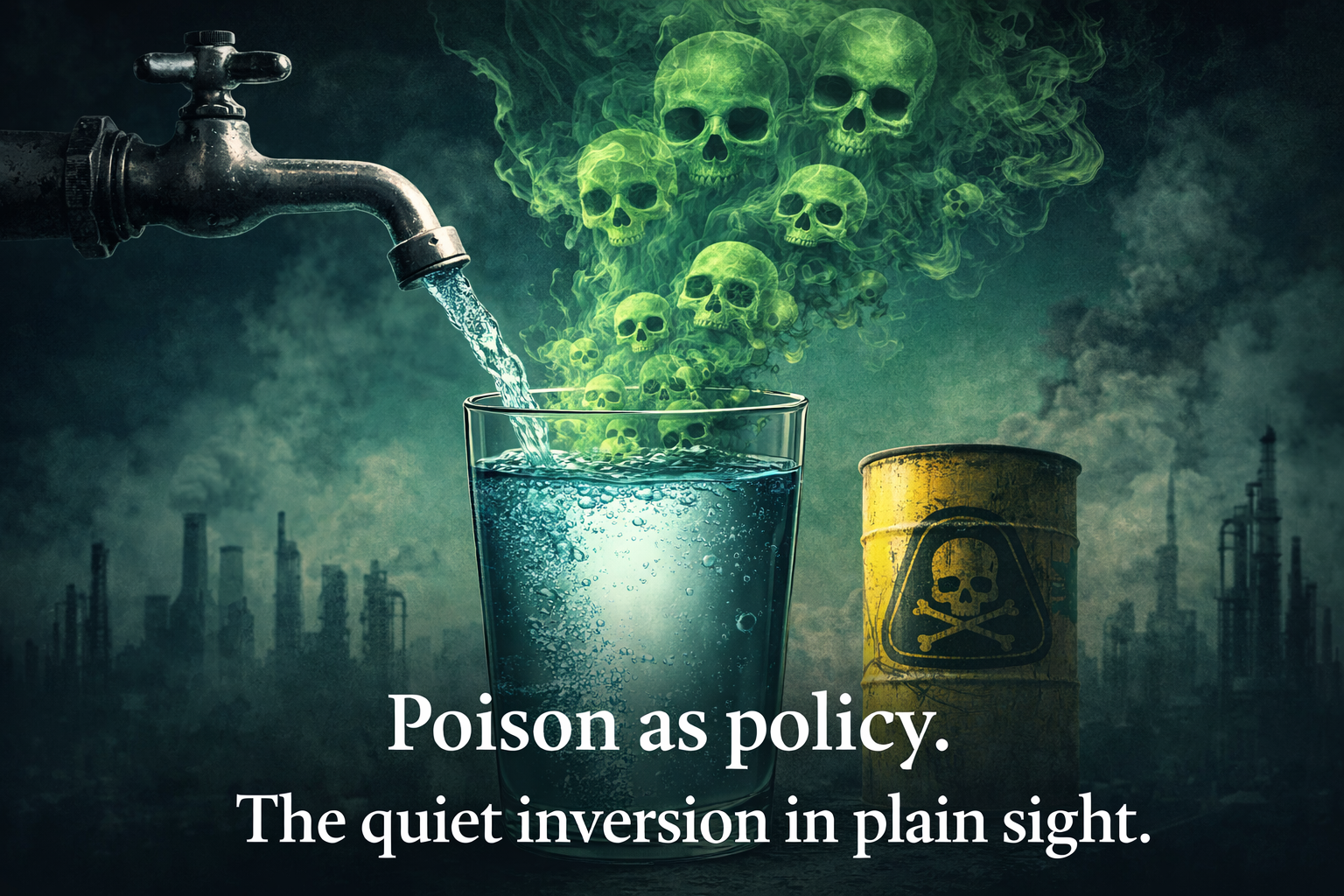
That framing is not accidental, and it is not neutral. It answers a question, but not the question that has been raised.
Because the concern has never been limited to whether fluoride exposure produces measurable changes in IQ within a constrained study window.
The concern is broader, and it extends into areas that are consistently excluded from formal analysis, most notably the long-term interaction between fluoride accumulation and the pineal gland, as well as the broader biological and perceptual systems that modern research does not attempt to measure.
Lets talk about IQ! (don't look over here at the pineal gland!).
At the center of this discussion is a chemical that occupies two very different identities depending on context. In one setting, it is handled with caution, labeled, regulated, and treated as something that requires strict boundaries. In another, it is introduced into public water systems and presented as benign, even beneficial, something so unremarkable that its presence requires no meaningful consent.
This contradiction is not difficult to identify. What is difficult is finding a space where it is examined honestly.
Instead, the conversation is narrowed, redirected, and simplified.
The justification most often presented is dental health, and there is data supporting the idea that fluoride can reduce tooth decay, particularly in populations with limited access to care.
That is not the issue under examination here. The issue is how that justification is expanded into a far broader policy, one that involves continuous, involuntary exposure through the most essential resource a population consumes.
There is no meaningful control over dosage at the individual level. Intake varies based on age, body composition, health status, and behavior.
A person who drinks more water receives more exposure, while another may receive less, and those with differing physiological sensitivities may respond in ways that are not captured by standardized models.
These variables are not peripheral. They are built into the system itself.
Yet the policy remains uniform.
The supply chain behind that policy introduces another layer that is rarely discussed in any serious way.
The compounds used in water fluoridation are often derived from industrial processes, particularly in the production of phosphate fertilizers. In their concentrated form, these substances are classified and handled as hazardous materials, requiring controlled transport, protective equipment, and strict regulatory oversight.
This is not conjecture. It is part of their documented handling requirements.
That is their identity at the point of origin.
What is remarkable is how seamlessly that identity is transformed once those same compounds enter the public domain. Once diluted, once reframed, and once embedded into infrastructure, the narrative changes.
The caution disappears, the complexity disappears, and what remains is a simplified message reinforced through repetition, that it is safe, that it is beneficial, and that the matter is no longer open for meaningful debate.
This reframing does not stop at municipal water systems. It extends into a global dental products industry that generates tens of billions of dollars annually, an industry built not only on treatment, but on daily habit and continuous exposure.
Toothpaste, mouthwash, and related products form a secondary layer of reinforcement, ensuring that exposure is not occasional but persistent, beginning in early childhood and continuing throughout life.
The scale of that system is not incidental. It reflects an embedded economic structure in which materials that would otherwise require costly disposal are instead converted into commodities, purchased, distributed, and normalized under the language of public health.
When a substance transitions from industrial byproduct to marketable input, it does not do so in a vacuum. It creates financial pathways, incentives, and dependencies that extend far beyond the chemistry itself.
Those incentives do not need to be hidden to be effective. They operate through alignment.
Within that alignment, research tends to follow predictable contours. Studies are designed around measurable endpoints, most often cognitive or behavioral metrics, and when those endpoints show minimal variation within defined exposure ranges, the results are presented as reassurance.
This latest study follows that exact pattern, reinforcing earlier work that confines the discussion to IQ and similar outcomes, while leaving broader biological questions untouched.
What is presented as a comprehensive answer is, in reality, a bounded one.
It does not address long-term accumulation. It does not address systemic interaction across multiple biological pathways. And it does not address the one structure that continues to sit at the edge of acknowledgment while remaining almost entirely unexamined.
The pineal gland.
In conventional terms, the pineal gland is understood to regulate melatonin and circadian rhythms, and that is where the discussion typically begins and ends.
What is acknowledged, but rarely explored in any meaningful way, is that this gland accumulates fluoride at higher concentrations than many other soft tissues, a phenomenon tied to its structure, vascularization, and natural tendency toward calcification over time.
The accumulation itself is not controversial.
What is avoided is the question of what that accumulation means.
Within mainstream literature, pineal calcification is often described as incidental or functionally irrelevant beyond its basic physiological role.
The conversation stops before it becomes uncomfortable. It does not examine whether accelerating that calcification through continuous exposure has broader consequences. It does not examine whether this uniquely situated structure plays a role that has not yet been fully understood.
And it does not engage at all with the fact that across cultures and throughout history, the pineal gland has been regarded as something far more significant than a simple regulator of sleep.
It has been described as the “third eye,” a point of perception, a biological interface between internal awareness and external reality.
These interpretations are not modern, and they are not isolated. They appear across civilizations that had no contact with one another, suggesting that they arise from a shared human experience rather than coincidence.
Modern science does not attempt to measure those dimensions, and so they are excluded from analysis.
But exclusion is not disproof.
If a biologically active compound accumulates in a structure that has not been fully understood, and if that accumulation is reinforced through continuous exposure beginning early in life, then the implications extend beyond what is currently being measured.
They extend into domains that remain outside the boundaries of formal inquiry, including perception, intuition, and the subtler aspects of cognition that are not captured by standardized metrics.
Those are the questions that are not being asked.
Instead, the public is presented with reassurance that IQ remains unaffected within a defined range, and that reassurance is used to imply that the system as a whole is safe, settled, and beyond further scrutiny.
This is not a full answer. It is a substitution.
It answers what is easiest to measure while ignoring what is most difficult to examine.
At the same time, the biological environment most directly impacted by this system, the oral microbiome, is treated as something to be suppressed rather than understood. Ancient medical traditions, across multiple cultures, placed significant value on maintaining balance within the body’s microbial ecosystems, including the mouth.
Modern approaches often move in the opposite direction, relying on broad antimicrobial strategies that reduce complexity in favor of control, without fully understanding the long-term consequences of that shift.
This too reflects a pattern. Complex systems are simplified. Subtle interactions are ignored.
Measurable outcomes are elevated above meaningful ones.
And through that process, the narrative becomes stable, even when the underlying questions remain unresolved.
The study released today does not close the discussion. It reinforces a boundary. It defines what is acceptable to measure, and by extension, what is acceptable to question. Everything outside that boundary is treated as though it does not exist, not because it has been disproven, but because it has been excluded.
We are told this is progress.
We are shown modern dental outcomes as proof of improvement, while older evidence, including ancient remains with intact dentition, is rarely integrated into the discussion in any meaningful way. The possibility that different systems of health once operated without continuous chemical intervention is not explored, because it does not align with the current model.
So the structure holds. The exposure continues. The industry expands. The questions remain unasked.
And the public is told, once again, that the matter is settled.
But when the frame itself is examined, when the limits of the inquiry are brought into view, a different question begins to emerge, one that sits outside the scope of any single study but speaks directly to the system as a whole.
Who benefits from keeping that scope this narrow?