The Man Who Explains Everything Away - The Problem of the Relentless Skeptic 

Here is a thought problem.

Let’s construct a popular “organic” disinformation figure for a specific “tough nut to crack” demographic.

The difficult to influence web savvy and sassy Gen X and Millenial’s. If possible, that could be a valuable asset- right!?

No one could find a better 3-letter-agency denial guy than Mick West. We are just using Mick as an easily understood and popular example for our model. I am sure he is an honest, independent critical thinking authentic and self motivated upstanding citizen.

Let’s use his public posts and behavior as a model of how it could be professionally done.

We don’t use some paid shill with obvious strings attached.

No, this is next-level.

Picture it: late ‘90s, Mick co-founds Neversoft and basically builds the first Tony Hawk games (plus Guitar Hero and Spider-Man).

Activision buys the company, he cashes out smart, and boom—he’s set for life. Living comfy in Sacramento off those millions.

No mortgage, no Patreon begging, no need for any deep-state check. That’s the genius cover.

A regular “independent skeptic” with zero funding trail to trace. He can crank out those massive Metabunk threads at 2 a.m. because his game-dev fortune already paid the bills years ago.

Perfect insulation.


And the gamer connection? That’s the real infiltration play. The Tony Hawk generation—us Gen X and Millennials who grew up grinding rails in those games—we’re exactly the crowd diving into conspiracy rabbit holes now.

Tech-savvy, anti-authority, forum warriors. Mick talks our language: physics engines, glitches, 3D sims.

When he fires up that Sitrec tool he built, it feels like your old skate game buddy reverse-engineering a level. Not some Langley suit.

Instant trust from the exact demographic they needed to reach.

Smart, but maybe too genius?

But here’s where things go off the rails. Too much overconfidence.

In this scenario our agent overplays the hand every single time: that knee-jerk enthusiasm.

Real skeptics might go “huh, interesting footage, let’s see more.” Mick? Nah. Anything outside the mainstream narrative and he’s instantly giddy, diving in with 10,000 words and custom sims like it’s Christmas.

If I’m in charge of this “op” or his handler, I’d ding him (and/or his emulators) on his being too consistent. Too fast. Too eager. That’s getting lazy boys.

That’s the psychological tell—classic op playbook.

Overcompensate so hard it sells the “passionate truth-teller” vibe, while training everyone else to parrot the same lines.

Take his biggest hits:

•Chemtrails: He crushes the whole “secret spraying fleet” thing with contrail charts and atmospheric data. Beta test complete—now his followers spam those same graphs on every new chem post. 
•9/11 iron microspheres and thermite: He goes full physics mode, explaining molten metal with office fires and 1600s Hooke’s law. Technical enough to sound legit, but that speed trains the sycophants to dismiss it all before they even read the evidence. 
•UFO Navy videos (Gimbal, GoFast, FLIR): Peak overplay. He reverse-engineers them in game engines, calls it glare or birds or parallax. Relentless. Every high-profile UAP gets the exact same treatment, no matter what the pilots or sensors say. Sitrec recreations become the go-to debunk template for every skeptic copycat.


This video is a breakdown by NotebookLM of this post:


This wasn’t random.

In my thought problem/theory, this was a low-key deep-state op cooked up around 2010-2015—post-chemtrails, right before the UAP disclosure wave.

Find or cultivate a wealthy, retired tech guy who already looks organic.

Give him the tools (or let him build them). Let his natural programmer brain do the rest.

Now you’ve got a self-sustaining disinfo machine.

Every new anomaly gets hit with the same enthusiastic “mundane explanation first and loudest.” His followers do the rest—copy-paste the Metabunk links and become unpaid amplifiers.

Mick never tells obvious lies.

The problem is he just overplays the calm rationalist role so perfectly it becomes the red flag.

Wealth keeps him clean.

Gamer cred buys the loyalty.

But watch out - The speed gives away the script.

I’d expect better from our three letter agency guys.

That’s my take. Mick West: the ultimate “independent debunker” who proves you don’t need a salary when your Tony Hawk stock already bought the perfect cover.

The more you examine his content in long form analysis it just smells bad, too fast, detailed, unauthentic and predictably knee-jerk.

If you’re not fooling me - you’re not doing it right.

So if I’m in charge of this operation- expect it to be way harder to spot.

These are rookie mistakes.

Flouride - Poison as Policy: The Quiet Inversion in Plain Sight 

The podcast I just did with Amir Jahangiri and Drago Reid (Spiritual Bros) featured a discussion on inversions - then today I woke up to a news story that put me right to work on this.

POISON AS POLICY: THE QUIET INVERSION IN PLAIN SIGHT

A new study is making the rounds all over the new today, presented as a definitive rebuttal to concerns raised by Robert F. Kennedy Jr., and framed in a way that suggests the issue has now been thoroughly examined and resolved. The tone is familiar, the language confident, and the conclusion arrives exactly where one would expect it to. Offered as a "gotcha" moment. 

What is less familiar, at least to those paying close attention, is how consistently these studies narrow the scope of inquiry in ways that avoid the most consequential questions. 

This latest work follows a well-established lineage, building on earlier analyses such as the Harvard meta-analysis and subsequent cohort studies published in journals like JAMA Pediatrics, all of which focus primarily on cognitive outcomes, particularly IQ, as though that single metric were sufficient to represent the full range of biological and neurological interaction at play.


That framing is not accidental, and it is not neutral. It answers a question, but not the question that has been raised.
Because the concern has never been limited to whether fluoride exposure produces measurable changes in IQ within a constrained study window. 

The concern is broader, and it extends into areas that are consistently excluded from formal analysis, most notably the long-term interaction between fluoride accumulation and the pineal gland, as well as the broader biological and perceptual systems that modern research does not attempt to measure.

Lets talk about IQ! (don't look over here at the pineal gland!).

At the center of this discussion is a chemical that occupies two very different identities depending on context. In one setting, it is handled with caution, labeled, regulated, and treated as something that requires strict boundaries. In another, it is introduced into public water systems and presented as benign, even beneficial, something so unremarkable that its presence requires no meaningful consent.

This contradiction is not difficult to identify. What is difficult is finding a space where it is examined honestly.

Instead, the conversation is narrowed, redirected, and simplified.
The justification most often presented is dental health, and there is data supporting the idea that fluoride can reduce tooth decay, particularly in populations with limited access to care. 

That is not the issue under examination here. The issue is how that justification is expanded into a far broader policy, one that involves continuous, involuntary exposure through the most essential resource a population consumes.

There is no meaningful control over dosage at the individual level. Intake varies based on age, body composition, health status, and behavior. 

A person who drinks more water receives more exposure, while another may receive less, and those with differing physiological sensitivities may respond in ways that are not captured by standardized models. 

These variables are not peripheral. They are built into the system itself.

Yet the policy remains uniform.

The supply chain behind that policy introduces another layer that is rarely discussed in any serious way. 

The compounds used in water fluoridation are often derived from industrial processes, particularly in the production of phosphate fertilizers. In their concentrated form, these substances are classified and handled as hazardous materials, requiring controlled transport, protective equipment, and strict regulatory oversight. 

This is not conjecture. It is part of their documented handling requirements.

That is their identity at the point of origin.

What is remarkable is how seamlessly that identity is transformed once those same compounds enter the public domain. Once diluted, once reframed, and once embedded into infrastructure, the narrative changes. 

The caution disappears, the complexity disappears, and what remains is a simplified message reinforced through repetition, that it is safe, that it is beneficial, and that the matter is no longer open for meaningful debate.

This reframing does not stop at municipal water systems. It extends into a global dental products industry that generates tens of billions of dollars annually, an industry built not only on treatment, but on daily habit and continuous exposure. 

Toothpaste, mouthwash, and related products form a secondary layer of reinforcement, ensuring that exposure is not occasional but persistent, beginning in early childhood and continuing throughout life.

The scale of that system is not incidental. It reflects an embedded economic structure in which materials that would otherwise require costly disposal are instead converted into commodities, purchased, distributed, and normalized under the language of public health. 

When a substance transitions from industrial byproduct to marketable input, it does not do so in a vacuum. It creates financial pathways, incentives, and dependencies that extend far beyond the chemistry itself.

Those incentives do not need to be hidden to be effective. They operate through alignment.

Within that alignment, research tends to follow predictable contours. Studies are designed around measurable endpoints, most often cognitive or behavioral metrics, and when those endpoints show minimal variation within defined exposure ranges, the results are presented as reassurance. 

This latest study follows that exact pattern, reinforcing earlier work that confines the discussion to IQ and similar outcomes, while leaving broader biological questions untouched.

What is presented as a comprehensive answer is, in reality, a bounded one.

It does not address long-term accumulation. It does not address systemic interaction across multiple biological pathways. And it does not address the one structure that continues to sit at the edge of acknowledgment while remaining almost entirely unexamined.

The pineal gland.

In conventional terms, the pineal gland is understood to regulate melatonin and circadian rhythms, and that is where the discussion typically begins and ends. 

What is acknowledged, but rarely explored in any meaningful way, is that this gland accumulates fluoride at higher concentrations than many other soft tissues, a phenomenon tied to its structure, vascularization, and natural tendency toward calcification over time.

The accumulation itself is not controversial.

What is avoided is the question of what that accumulation means.
Within mainstream literature, pineal calcification is often described as incidental or functionally irrelevant beyond its basic physiological role. 

The conversation stops before it becomes uncomfortable. It does not examine whether accelerating that calcification through continuous exposure has broader consequences. It does not examine whether this uniquely situated structure plays a role that has not yet been fully understood.

And it does not engage at all with the fact that across cultures and throughout history, the pineal gland has been regarded as something far more significant than a simple regulator of sleep.
It has been described as the “third eye,” a point of perception, a biological interface between internal awareness and external reality. 

These interpretations are not modern, and they are not isolated. They appear across civilizations that had no contact with one another, suggesting that they arise from a shared human experience rather than coincidence.

Modern science does not attempt to measure those dimensions, and so they are excluded from analysis.

But exclusion is not disproof.

If a biologically active compound accumulates in a structure that has not been fully understood, and if that accumulation is reinforced through continuous exposure beginning early in life, then the implications extend beyond what is currently being measured. 

They extend into domains that remain outside the boundaries of formal inquiry, including perception, intuition, and the subtler aspects of cognition that are not captured by standardized metrics.

Those are the questions that are not being asked.
Instead, the public is presented with reassurance that IQ remains unaffected within a defined range, and that reassurance is used to imply that the system as a whole is safe, settled, and beyond further scrutiny.

This is not a full answer. It is a substitution.

It answers what is easiest to measure while ignoring what is most difficult to examine.

At the same time, the biological environment most directly impacted by this system, the oral microbiome, is treated as something to be suppressed rather than understood. Ancient medical traditions, across multiple cultures, placed significant value on maintaining balance within the body’s microbial ecosystems, including the mouth. 

Modern approaches often move in the opposite direction, relying on broad antimicrobial strategies that reduce complexity in favor of control, without fully understanding the long-term consequences of that shift.

This too reflects a pattern. Complex systems are simplified. Subtle interactions are ignored.

Measurable outcomes are elevated above meaningful ones.
And through that process, the narrative becomes stable, even when the underlying questions remain unresolved.

The study released today does not close the discussion. It reinforces a boundary. It defines what is acceptable to measure, and by extension, what is acceptable to question. Everything outside that boundary is treated as though it does not exist, not because it has been disproven, but because it has been excluded.
We are told this is progress.

We are shown modern dental outcomes as proof of improvement, while older evidence, including ancient remains with intact dentition, is rarely integrated into the discussion in any meaningful way. The possibility that different systems of health once operated without continuous chemical intervention is not explored, because it does not align with the current model.

So the structure holds. The exposure continues. The industry expands. The questions remain unasked.

And the public is told, once again, that the matter is settled.
But when the frame itself is examined, when the limits of the inquiry are brought into view, a different question begins to emerge, one that sits outside the scope of any single study but speaks directly to the system as a whole.

Who benefits from keeping that scope this narrow?

URGENT: Oppose the NSW Central Coast Strategic Conservation Plan - Links and Resources 

AMAZING NEWS FROM AUSTRALIA — GOVERNMENT AGENCIES WORKING QUICKLY!

The phenomenon would always be noteworthy — but in this case, it’s being used to steamroll changes to how ecologically sensitive and culturally priceless Indigenous lands are being handed to developers.

November 11, 2025 is the deadline for public submissions, but with less than a week’s notice, a hearing on this so-called “conservation” plan was scheduled for Tuesday, November 4 — just two days from the creation of my video.

That doesn’t mean you shouldn’t act — follow the steps below. Everything about this is unsavory: the speed, the secrecy — it’s a hush-hush handoff.

Under the GIPA Act — Australia’s equivalent of the Freedom of Information Act — requests for transparency have been ignored. That alone should raise alarms.

Now — here’s what’s really happening.


Mortals of Earth — Quick, Urgent Update

The NSW draft Central Coast Strategic Conservation Plan is on public exhibition. The plan covers about 3,069 hectares (~7,584 acres) and includes places we all care about — including Kariong sacred lands surrounding the Gosford Glyphs. They call it “conservation.” Don’t buy it.

This looks like a land-grab dressed up as planning to push housing targets, clear country, and hand huge profits to insiders while irreplaceable ecological and cultural values are lost forever.

This isn’t garden-variety bad policy — this is systemic capture. The grift runs through planning bodies, consultants, and developers — a coordinated process that certifies land for clearing, then pretends the damage is fixed by offsets that never replace local ecosystems or ancestral country. That’s corruption — it demands independent investigation, full transparency, and, where the evidence supports it, prosecution.

To those responsible: I’m not talking to your PR machines that watch Google Alerts 24/7 and rabidly respond with disinformation, defamation, or trolling. I’m speaking to your souls. The ancestors see you. They have assembled and bear witness. Their presence is a reminder that history, community, and the law watch what’s being done. The ancestors are not powerless. You still have a choice to do the right thing.


What You Can Do Right Now

Make a submission before 11 November 2025.

Email: chelsey.blondel@dphi.nsw.gov.au

Exhibition page (details, documents, RSVP links):
NSW Planning Exhibition Portal — Central Coast SCP

Demand an independent public audit — consultant appointments, conflict-of-interest declarations, land-value modelling, and offset contracts. If wrongdoing is found, demand prosecution and sanctions.

Show up and make a record. Attend webinars and in-person feedback sessions; put your objections on the public record.

Follow the money. Push for full disclosure of who benefits from each certification — developers, consultants, modelling firms, and any related parties. Demand contracts, memos, and financial modelling be released. Sunlight is the enemy of secrecy.

Document the disinformation and bullying. Expect manufactured “news,” paid commenters, hit pieces, and troll swarms. Archive screenshots, save links, and record dates/sources.

Don’t be intimidated. Expect smear tactics and coordinated harassment. Stay calm, factual, and coordinated with community groups.

If you have solid, verifiable documentation, share it responsibly — with independent oversight groups, credible journalists, or lawful investigative channels. Facts and evidence speak louder than outrage.


Copy-and-Paste Submission Template

Subject: Opposition to Central Coast Strategic Conservation Plan certification

101 REASONS to OBJECT to the Draft Central Coast Strategic Conservation Plan

Submission for Draft Plan for The Central Coast’s Urban Growth and Environment

I oppose certification of the Central Coast Strategic Conservation Plan. This area includes irreplaceable ecological and cultural values, including Kariong sacred lands, and in-situ protection is required. Offsets are not an adequate substitute.

I call for an independent, public audit of the Plan’s consultant appointments, conflict of interest declarations, land-value modelling and offset contracts. If wrongdoing is found, I call for prosecution and appropriate sanctions.

I demand the Plan be paused until independent cultural heritage and ecological protections are embedded and enforced.

Where to send (copy any relevant representatives):

Exhibition/plan team: ccscp@planning.nsw.gov.au

NSW Department of Planning, Housing and Infrastructure (Central Coast Strategic Conservation Planning Team)

Local MPs (examples):

gosford@parliament.nsw.gov.au

wyong@parliament.nsw.gov.au

TheEntrance@parliament.nsw.gov.au


FOI / GIPA and Transparency Tools

File FOI (GIPA) requests: RightToKnow.org.au

FOI guidance (Australia): OAIC FOI Guidelines

If you’ve already lodged GIPA requests and they’re being ignored, note that in your submission and correspondence: delays or non-responses during an active exhibition period are themselves a public-interest concern.


🌱

Here are some key dates and ways to get involved:


🌿

CEN Webinar – Wednesday 29 October, 7pm
An online session hosted by the Community Environment Network explaining what the plan means and how to make an effective submission.
 

👉

Register here for the Zoom link: https://cen.org.au/event/stop-the-conservation-liquidation-plan-webinar/


✋

Join Hands to Save Kincumber Wetlands Rally – Saturday 1 November, 4pm
 

📍

Corner Carrak Road & Avoca Drive, Kincumber
This last bit of Kincumber wetland is listed on the plan. Come along, hold a sign, and show support for protecting this vitally important biodiversity area earmarked for a Woolworths supermarket.


🌏

Coasties Unite Community Event – Sunday 2 November, 3–5pm
 

📍

Norah Head Sporties (Victoria Street, Norah Head, NSW 2263)
A family-friendly event with entertainment, speakers, and a submission-writing session to help equip you to take action.


🤝

Central Coast Activists Meeting – Wednesday 5 November, 11.30am–1pm
 

📍

Ourimbah RSL
CEN Chair Garry Chestnut will present on the plan and what it means for our region.


LINK to the latest media release


Final Word

The backroom politics have been hidden long enough. I’m calling for independent investigations and accountability. Those driving this agenda have underestimated you. They assume people are distracted, ignorant, or too uninformed to notice the inconsistencies, conflicts of interest, and patterns of deception. Let’s prove them wrong.

This kind of corruption leaves a trail — and there are laws to deal with it. Shine such a bright light on it that the enforcement system cannot ignore it.

Mortals of Earth — we have the power to make this a pivotal event.
Stay curious. Take action. The clock is ticking.


Quick Reference (shareable)

Deadline: 11 November 2025

Submit to: chelsey.blondel@dphi.nsw.gov.au, ccscp@planning.nsw.gov.au

Exhibition info/docs: NSW Planning Exhibition Portal

FOI (GIPA) tool: RightToKnow.org.au

FOI guidance: OAIC FOI Guidelines

CC your MPs: gosford@parliament.nsw.gov.au, wyong@parliament.nsw.gov.au, TheEntrance@parliament.nsw.gov.au

What Lies Beneath: The Hidden Link Between Egypt and Australia  

Mortals of Earth:

I need to tell you something that should make your blood boil. Because it’s not just a story about sacred land—it’s a story about power, greed, corruption, and how far governments and corporations will go to bury our history.

Let me take you to Kariong, Australia. A sacred site. A spiritual and archaeological treasure. And now? A target for destruction.

Why?

Because beneath its soil lies a truth that threatens to upend the tidy little narrative we’ve all been sold—that ancient civilizations were isolated, primitive, and disconnected. But Kariong doesn’t fit that mold.

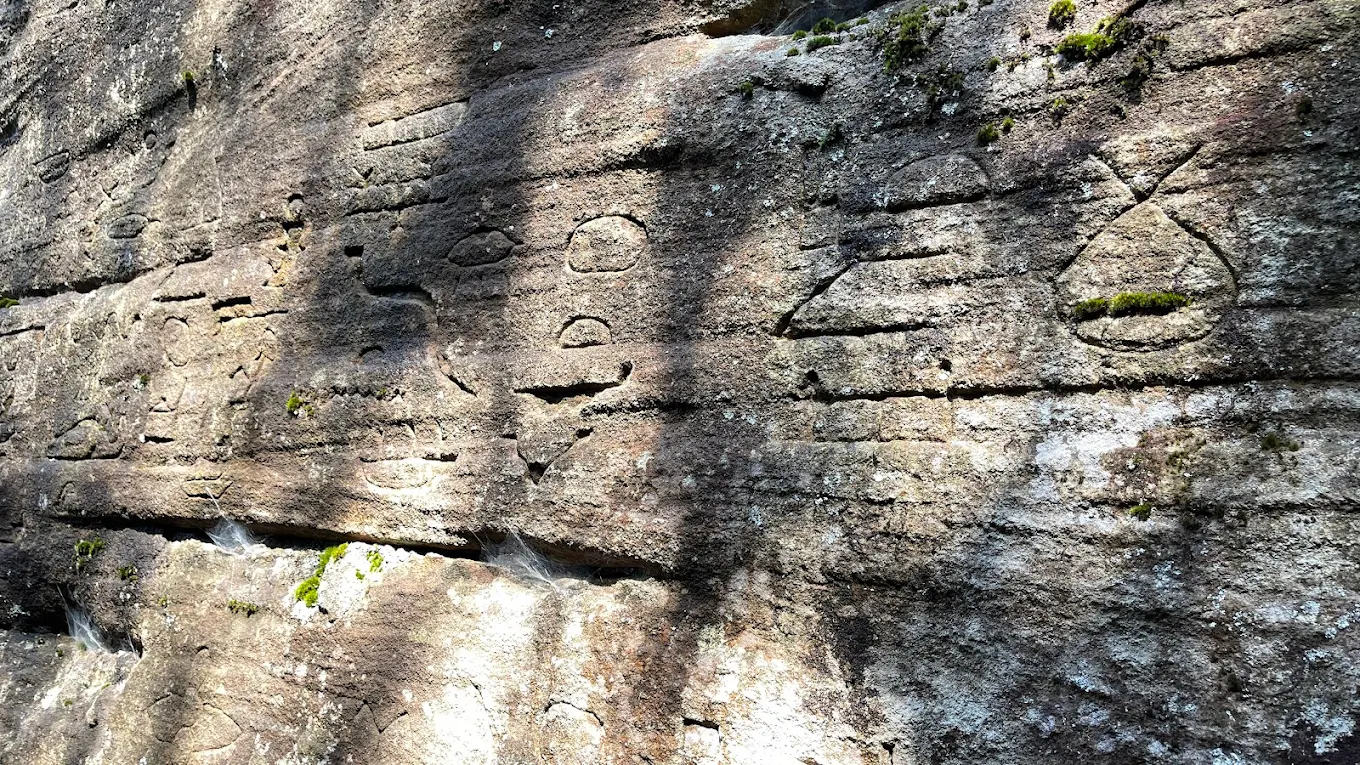
You may have heard whispers about the Gosford Glyphs—a set of Egyptian hieroglyphs carved into stone in New South Wales. For decades, they were dismissed as a hoax, graffiti, or amateur forgeries.

But here’s the twist—they’re not fake.


I know because I’ve toured Egypt multiple times with one of the top minds in ancient Egyptian history—Mohamed Ibrahim. He grew up in the shadow of the pyramids, has lived and breathed ancient Egypt for decades, and unlike what Wikipedia once claimed—he’s no “amateur.” He’s a scholar, a researcher, and someone with the rare ability to recognize subtle variations in script style that span thousands of years.

When photos of the Kariong glyphs surfaced, many shrugged them off. But Mohamed didn’t. He stepped forward. He looked at the glyphs and immediately recognized not only their authenticity—but their age. Because like our own language, hieroglyphs evolved. A single symbol, stroke, or structure can date a carving to a specific dynasty. And Mohamed could see the layers.

What he found shocked him—and it should shock you too.

He confirmed: these glyphs are real. They match known variants from Egypt’s Middle Kingdom period, including phrases and symbology consistent with funerary texts.

And now, the land around these glyphs is being handed over for development.

Let me be clear—this isn’t just a little encroachment. This is a coordinated attack on a sacred landscape—a global archaeological site of profound significance.

Right now, the NSW Department of Planning and Infrastructure is reviewing a proposal to rezone the area at 300 Woy Woy Road, just 200 meters above the glyphs, to make way for housing. Yes—right above one of the most mysterious inscriptions on the planet.

Locals have been fighting tooth and nail to stop this. Researchers, Indigenous elders, environmentalists, and citizens who understand the true value of this land have submitted complaints, presented evidence, documented the corruption.

And what did they get?

Dismissed.

They were told they were outside the 12-month complaint window. That their evidence was “too old” to be acted upon.

Let me tell you what isn’t too old—4,600-year-old carvings. Aboriginal etchings. A verified star map of Orion’s Belt. Endangered species. Protected koala habitats. A sacred healing table. A hanging swamp. Unique flora found nowhere else on Earth.

And yet, in the eyes of the system, that’s not worth preserving.

Do you feel it yet?

There’s a much bigger plan here. The Kariong rezoning is just the test case. If it goes through, it paves the way for over 2,000 additional parcels of former Crown Land across the Central Coast to be handed over to developers.

How?

By laundering it through bureaucracy.

You see, this land was granted to the Darkinjung Local Aboriginal Land Council, a NSW government-backed body with memorandums of understanding with other departments. That sounds good on the surface, until you realize they’re working hand in glove with planners to push through rezoning without proper protection or heritage classification.

I’m not here to demonize anyone—but I will say this: when sacred land becomes a bargaining chip, the lines between stewardship and exploitation get blurry real fast.

Here’s where it gets downright infuriating:

Multiple formal complaints were submitted—to ICAC, the Independent Commission Against Corruption, and to the NSW Ombudsman. Detailed. Documented. Supported by emails, dates, and timelines from community advocates like Jake Cassar and others.

And they were flat-out ignored.

ICAC said, “There’s no reasonable likelihood of corrupt conduct.”
The Ombudsman said, “Too much time has passed.”
They both claim there’s nothing more to do.

But the truth is, this is the same playbook used around the world—delay, deflect, dismiss. Run the clock out until people get tired or give up.

But guess what? We’re not giving up.

We see what’s happening. The people who stand to gain from this development want the public to stay distracted. They want the world to believe this is just another piece of scrubland.

But it’s not. It’s a keystone. A missing piece in the puzzle of our ancient past.

According to Mohamed Ibrahim, some of the glyphs indicate underground knowledge, or even hidden structures. That means what we see above ground might be just the beginning.

Let that sink in.

A potentially ancient global connection—linking Egypt to Australia—being erased by bulldozers and paperwork.

And let me ask you this: if they succeed here, where’s next?

The Bosnian pyramids? The mounds in Ohio? The drowned city off the coast of India?

How many ancient truths are being buried in silence, wrapped in red tape, and sold off to the highest bidder?

This is why I created Mortals of Earth.
Because we are at a tipping point—not just in our environment, but in our understanding of who we are, and where we come from.

If we let them destroy this—we lose more than a patch of land.
We lose the story of ourselves.

So here’s what you can do:

📣 Share this video.

📬 Write to the NSW government—even if you don’t live in Australia.

🔗 Watch the full interview with Mohamed Ibrahim and those protecting Kariong: https://youtu.be/5V8zFV2LxR8?si=DhflKGZi7_1ol_vc

🧠 Educate others. Challenge the mainstream narrative. Keep asking questions.

Because they won’t stop unless we shine a light. And the only way to fight darkness is with awareness.

Enough is enough. The game is over.

We stand with Kariong.
We stand with the ancestors.
We stand with truth.

Stay curious—and have a good one.

https://mortalsofearth.com/files/1363367/kariong-s-ancient-secrets-egyptian-glyphs-in-australia-and-the-fight-to-save-a-world-changing-site.m4a

Meta Is Infiltrating Facebook Groups with AI Mods – You Can’t Delete Them  

Mortals of Earth – you NEED to hear this! If you’re running a Facebook group, I’ve got a wild story from my friend that’ll make your jaw drop. Meta’s sneaking an AI moderator into groups, and it’s taking over like some sci-fi villain. It’s not just annoying – it’s a total violation of your control. Let me break it down and tell you how to keep this AI out of your group before it’s too late.

So, my friend’s been building their Facebook group for *years*, right? It’s their baby – they’ve poured their heart into moderating it, making it a real community. Then, out of nowhere, this “member” called Aurora Guide starts posting, approving stuff, and acting like they own the place. At first, my friend’s like, “Who’s this?” Turns out, it’s not a person – it’s an AI Meta created, with a fake profile pic and a personality to trick everyone into thinking it’s a legit admin. This thing’s making posts, replying to comments, summarizing discussions, even starting chats! Members are chatting with it, thinking it’s someone my friend trusts. *Insane*, right?

Here’s the kicker: my friend didn’t sign up for this. They were just approving posts one day, clicked something by mistake, and – *boom* – this AI’s in their group, running the show. They tried turning off its features, like stopping it from commenting or approving posts, but they *can’t delete it*. It’s like Meta’s glued it to the group! My friend’s fuming, yelling, “Get your AI trash outta my group, Facebook! I’ve got this covered!” But Meta’s like, “Nah, you need our AI whether you want it or not.” It feels like a punch in the gut – someone hijacking a community you’ve built from scratch.

And it’s not just my friend. I’ve seen people on X and Reddit losing it over this. One admin said they clicked “Try Admin Assist” without realizing it, and next thing they know, Meta’s AI is moderating their group. Another person was like, “I can’t ban this thing!” It’s a pattern – Meta’s pushing this AI to “help” with stuff like flagging posts or summarizing comments, but it’s way more than that. It’s deceptive, it’s pushy, and it’s *everywhere*.

So, how do you keep this AI from crashing your party? Listen up, here’s what you gotta do:  

First, jump into your group settings *today*. Go to Admin Tools, find Group Settings, and look for something called Admin Assist. That’s where Meta hides the AI stuff. Turn off *every* automated rule – like “remove reported posts” or “approve posts automatically.” If you see a weird profile like “Aurora Guide” under Members or Admins, try kicking it out. Click the three dots, hit Remove as Admin or Remove from Group. Fair warning: Meta might not let you fully delete it, but you can at least clip its wings.

Second, mute or block the AI if it’s popping up in chats or comments. Search for it in the app, tap the little “i” icon, and hit Mute – pick “Until I change it” to shut it up for good. You can also try blocking it from its profile, but Meta’s tricky, so it might still lurk.

Third, check your Admin Activity Log in Admin Tools. See what this AI’s been up to – maybe it approved posts or deleted stuff behind your back. Undo anything sketchy and make sure posts need a human admin’s OK from now on.

Fourth, watch out for Meta’s sneaky prompts. They’ll throw up buttons like “Try Admin Assist” or “Add Feature” when you’re busy. *Don’t click ‘em*! Tell your co-admins to steer clear, too. One wrong click, and you’re stuck with this AI forever.

Fifth, if the AI’s already causing chaos, report it to Facebook. Go to Settings & Privacy, then Help & Support, and file a complaint. Say the AI’s messing with your group. Honestly, Meta’s support is kinda useless, but it’s worth a shot.

Last tip: if things get bad, try using mbasic.facebook.com on a browser. It’s an old-school version of Facebook without all the AI nonsense. It’s not pretty, but it works. Worst case, you might have to pause your group or even start a new one to ditch the AI – yeah, it’s *that* serious.


Look, this isn’t just about one group. It’s about Meta thinking they can waltz in and take over spaces we’ve built with love and sweat. My friend’s group feels like it’s under attack, and I bet some of you are nodding along, thinking, “Yup, I’ve seen this AI crap too.” So, spread the word! Tell every admin you know – post this in your group, share it on X with hashtags like #FacebookAI or #GroupAdmins, text your buddies. If we make enough noise, maybe Meta’ll give us a real opt-out.

If you’re already dealing with this AI, hit me up – I’ll pass along any new tricks we find. Let’s fight back and keep our groups *ours*. Who’s with me? Thats all for now, stay curious, and have a good one!


Can AI Rebuild Ancient Egypt? The Forgotten Ruins of Karnak and Tanis  

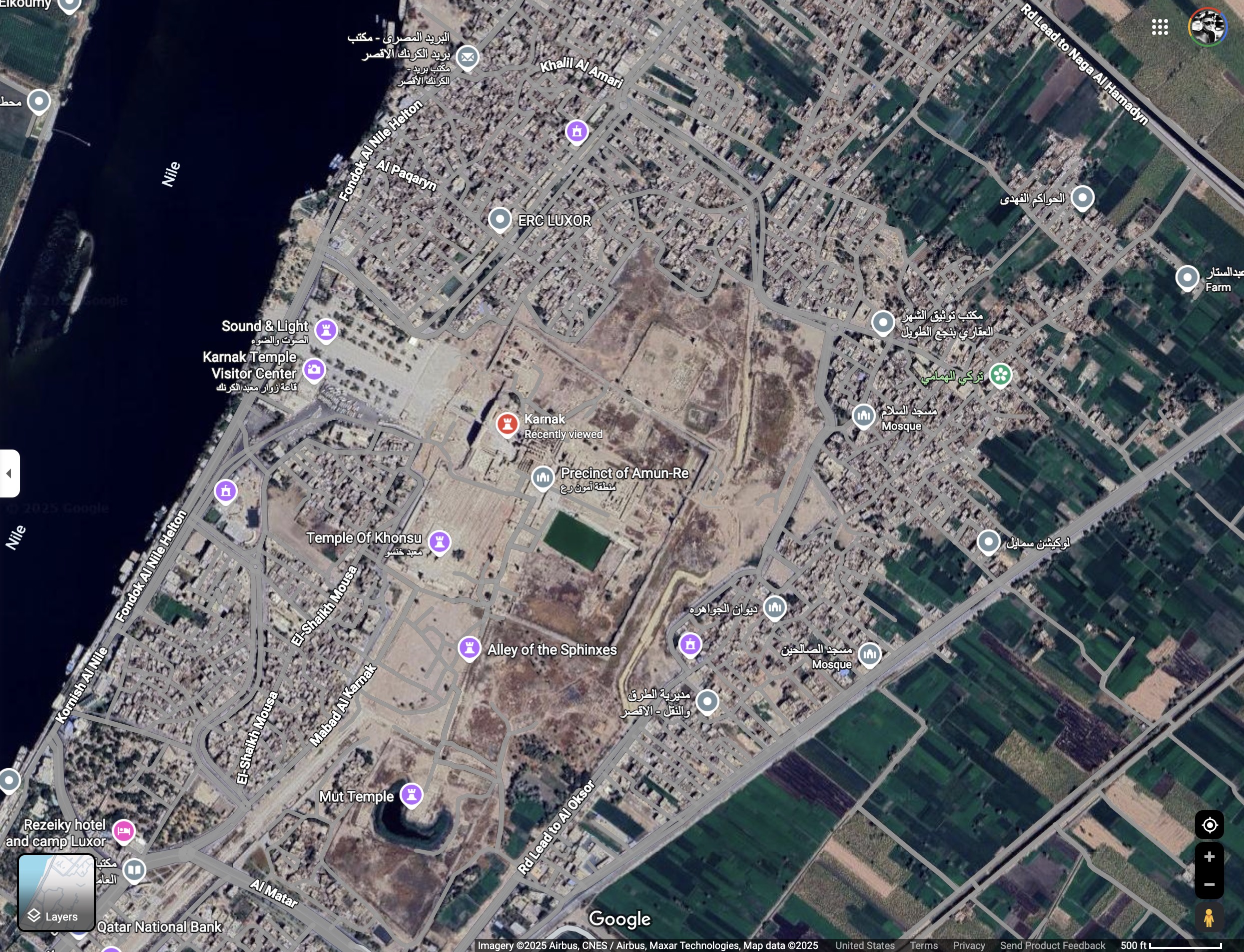
Karnak Temple from above, much of the area enclosed around the temple is unescavaed debrisdebris

Can AI Rebuild Ancient Egypt—Piece by Piece?

Across Egypt, some of the world’s most iconic and mysterious ruins remain in fragments—massive blocks, statues, and columns scattered across fields, buried in mud, or stacked without clear context. What if we had the tools to digitally reassemble these shattered monuments and finally uncover what they once looked like, how they fit together, and what they meant?

The truth is, we do.


The Puzzle Beneath Our Feet

At the Karnak Temple Complex near Luxor, one of the most visited ancient sites in the world, there exists far more than just the standing columns and reconstructed halls seen in tourist photos. Behind and around the restored sections lies a vast debris field—acres of broken architectural elements, many of which remain unstudied or unidentified.

To give a sense of scale: the rubble field at Karnak could easily cover the equivalent of 20 or more football fields. It is an open-air archive of disassembled history, much of it overlooked or informally arranged in ways that are not representative of the original structures.

And Karnak is not the only site where this situation exists.

At Tanis, in the Nile Delta, a once-powerful capital of ancient Egypt, massive architectural remains lie buried under layers of Nile silt and mud. Among them are obelisks, statues, and structural blocks that once formed entire temple complexes. Today, much of this material is largely inaccessible using conventional excavation methods.

Elephantine Island is another incredible, intriguing debris field of an ancient site. The tantalizing fragments scattered about hint at the majesty of an incredible complex. 


The Technology to See What We Can’t

Modern non-invasive survey technologies have advanced to the point where full-site 3D scanning is not only feasible, but cost-effective at scale. Tools such as:

LiDAR (Light Detection and Ranging)

Ground-penetrating radar (GPR)

Synthetic aperture radar (SAR)

High-resolution photogrammetry

...can produce accurate, high-fidelity digital models of entire landscapes, including buried structures and individual stones.

These technologies can be deployed without disturbing the site physically, preserving its integrity while capturing the data needed for analysis and reconstruction.


Artificial Intelligence as Reconstruction Tool

Once the relevant 3D data is collected, artificial intelligence and machine learning algorithms could be used to analyze and reconstruct ancient structures in ways that are not humanly possible at scale.

AI can:

Analyze break lines, material properties, surface patterns, and tool marks

Identify matching fragments across thousands of individual pieces

Recreate likely original configurations

Predict missing segments using probabilistic modeling

Flag pieces that are contextually or temporally inconsistent

This is not a speculative future. These technologies exist now and are used in medical imaging, structural engineering, facial reconstruction, and even archaeological conservation on a limited basis. The difference here is scale and the integration of diverse disciplines.


Rebuilding What History Tried to Erase

There is growing evidence that sites such as Karnak and Luxor were not constructed in a single phase. Instead, they show signs of multiple building periods, reconstructions, and potentially catastrophic events that caused widespread destruction.

Some architectural elements have been repositioned in modern times without accurate knowledge of their original locations. Others were reused from older structures. Still others have never been identified. Many temple complexes appear to have been constructed over even older foundations, raising important questions about the true antiquity of these sites.

Digital reconstruction, supported by AI, offers a path toward a clearer understanding of how these sites evolved—and what may have come before them.


Why This Matters

Digitally reconstructing ancient Egyptian sites is not just about aesthetics or tourism. It could answer foundational questions such as:

What did these sites originally look like, and how did they function?

How were they oriented in relation to geography and celestial patterns?

Were there earlier phases of construction we have not yet recognized?

What cultural or religious purposes did these arrangements serve?

How do these reconstructions compare to known architectural norms or anomalies in other ancient civilizations?

This research has implications for our understanding of human development, cultural transmission, technological capability, and the resilience or fragility of ancient societies.


A Field in Need of Openness

Despite the availability of modern tools and data-driven methodologies, much of the public narrative around Egyptian history remains rooted in 20th-century interpretations. The notion that pyramids were simply tombs or that temple construction followed a fixed dynastic timeline continues to dominate textbooks and mainstream discourse.

This rigidity does not reflect the exploratory, evidence-driven spirit of early Egyptologists, many of whom embraced the complexity and ambiguity inherent in their discoveries. Today, a more interdisciplinary and open-minded approach is overdue.

We now have the tools to revisit old assumptions with new methods.


What Comes Next?

To date, no large-scale project has been publicly proposed to digitally reconstruct the debris fields of Karnak, Luxor, or Tanis using AI and full-spectrum 3D scanning. Yet the technology is readily available, the scientific interest is strong, and the potential insights are profound.

This is not a fringe idea. It is a research frontier.

If we want to understand the origins of complex societies, the evolution of symbolic architecture, and the deeper history of human civilization, then we must be willing to use every tool at our disposal—and to ask questions that challenge what we think we know.

The physical evidence is lying in pieces across acres of ground. It’s time to pick them up—digitally—and see what story they are still waiting to tell.


THE REAL UNDERGROUND: Why I Recreated a Chat About the Discovery That Should Have Shattered History  

(streaming audio only version of video below this)

What do you do when you come across a conversation so important, so mind-bending, so criminally overlooked by the mainstream, that you can’t stop thinking about it?

You recreate it.

Dr. Manu Seyfzadeh

That’s exactly what I did when I found the published transcript of a conversation between Dr. Manu Seyfzadeh and ChatGPT—one that dives deep into a revolutionary breakthrough by Dr. Filippo Biondi and his team, who scanned beneath the Giza Plateau and found massive underground structures using Synthetic Aperture Radar (SAR)

These structures aren’t just random cavities—they appear intelligently designed, symmetrical, and staggeringly deep, some over 1.2 kilometers below the surface.

This isn’t fringe speculation. This is science. Real science. Physics, signal processing, vibration analysis, Doppler filtering, inversion algorithms. And Biondi isn’t a YouTuber making wild claims. 

He’s a peer-reviewed physicist with over 88 scientific papers to his name, including earlier confirmed SAR studies that mapped known structures to astounding accuracy.

So why did I recreate this conversation?

Because important truths get buried, and not just under limestone bedrock. When the team unveiled these discoveries in February 2025, the public didn’t get a clear explanation. 

The press conference was in Italian. The visuals were technical. And the world media? Silent—or worse, dismissive.

And here’s where it gets ugly.

Instead of serious scientific discussion, we got YouTubers and archaeologists with no physics background calling it all "bullshit"

One such "expert" is Flint Dibble, who seems to have made it his full-time job to gaslight actual scientists and journalists like Graham Hancock. Another is Milo Rossi, a guy who’s more into drama than data. 

Their podcast? Ironically titled "Uniting YouTube Against Fake History Fraud". Translation: uniting ignorance against inconvenient discoveries.

It’s enraging. Because archaeology is not a hard science. It’s a branch of the humanities. Yet these self-appointed gatekeepers think they can overrule teams using advanced radar algorithms and satellite data to see through the Earth—something no traditional excavation has ever done.

This video dramatization of Seyfzadeh’s chat with ChatGPT captures what these critics never could: the science behind the discovery. It’s clear. It’s visual. It explains:

  • Why peer review isn't always the gold standard when the method has already been validated on known structures, volcanoes, dams, and even CERN’s underground tunnels.
     
  • How SAR doesn't just penetrate the ground—it picks up micromotions on the surface that reveal what lies far beneath.
     
  • How structures under all three Giza pyramids are shockingly similar, suggesting a single origin and possible connection to a civilization far older than dynastic Egypt.
     
  • Why critics who don’t even know what SAR is are totally unqualified to dismiss this research.
     
  • How Biondi’s “inversion process” transforms satellite radar into three-dimensional underground maps.
     

One of the best lines from the original chat?

“We are bullshit. But we are the ones giving results. The scan pyramid is gold—but it gave no results. So why is our bullshit the only one producing data?”

Now that’s a mic drop.

This is the kind of discussion that can change how we see the past. It’s a hard slap to the face of the dusty orthodoxy that’s spent decades guarding the gates of academic archaeology. And it’s a beacon to anyone who’s ever suspected that we’re being kept in the dark about our origins—sometimes deliberately.

So if you’ve ever wondered:

  • Could the pyramids have a hidden function?
     
  • Is there a vast underground network beneath Egypt?
     
  • Could free satellite data be the key to revealing ancient secrets?
     
  • Why do the real experts keep getting silenced?
     

Then this video is for you.

And let me say—if you’ve ever listened to a podcast while jogging, doing dishes, or commuting, this one is worth your time. It’s not just a recreation. It’s a rescue mission for a conversation that deserves to be heard, shared, and debated.

Watch it. Share it. Rage about it if you must. Just don’t ignore it.

Because while the self-appointed high priests of orthodoxy are busy rolling their eyes, the future of history is being rewritten—by satellites, science, and those who dare to ask better questions.

Link to transcript of Manu Seyfzadeh original conversation with ChatGPT about Biondi Protocol

Link to all scans from March 15, 2025 Press conference by Dr. Filippo Biondi, Armando Mei , Corrado Malanga

  • 1 comment
  • Share