
Can AI Rebuild Ancient Egypt—Piece by Piece?
Across Egypt, some of the world’s most iconic and mysterious ruins remain in fragments—massive blocks, statues, and columns scattered across fields, buried in mud, or stacked without clear context. What if we had the tools to digitally reassemble these shattered monuments and finally uncover what they once looked like, how they fit together, and what they meant?
The truth is, we do.
The Puzzle Beneath Our Feet
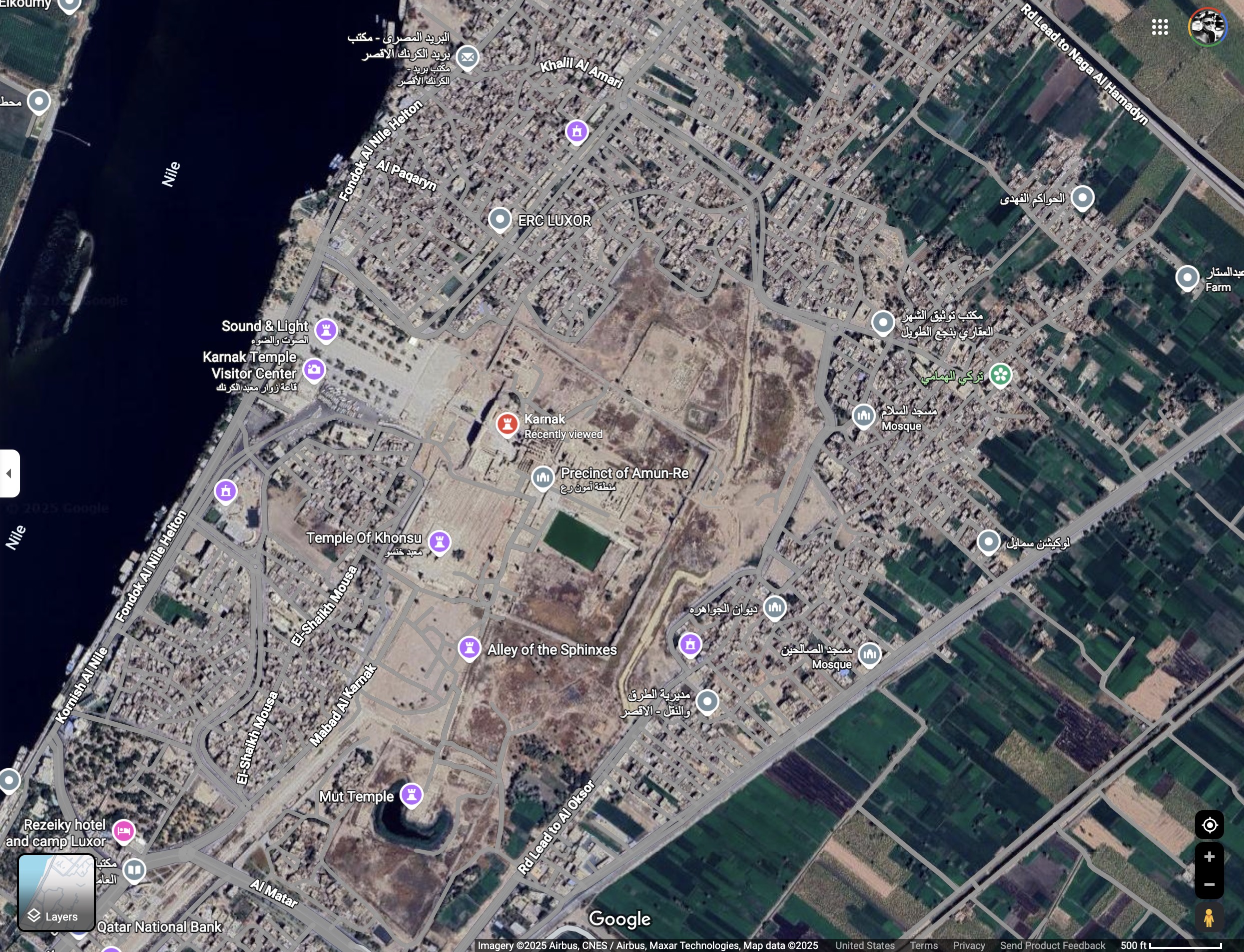
At the Karnak Temple Complex near Luxor, one of the most visited ancient sites in the world, there exists far more than just the standing columns and reconstructed halls seen in tourist photos. Behind and around the restored sections lies a vast debris field—acres of broken architectural elements, many of which remain unstudied or unidentified.
To give a sense of scale: the rubble field at Karnak could easily cover the equivalent of 20 or more football fields. It is an open-air archive of disassembled history, much of it overlooked or informally arranged in ways that are not representative of the original structures.
And Karnak is not the only site where this situation exists.
At Tanis, in the Nile Delta, a once-powerful capital of ancient Egypt, massive architectural remains lie buried under layers of Nile silt and mud. Among them are obelisks, statues, and structural blocks that once formed entire temple complexes. Today, much of this material is largely inaccessible using conventional excavation methods.
Elephantine Island is another incredible, intriguing debris field of an ancient site. The tantalizing fragments scattered about hint at the majesty of an incredible complex.
The Technology to See What We Can’t
Modern non-invasive survey technologies have advanced to the point where full-site 3D scanning is not only feasible, but cost-effective at scale. Tools such as:
LiDAR (Light Detection and Ranging)
Ground-penetrating radar (GPR)
Synthetic aperture radar (SAR)
High-resolution photogrammetry
...can produce accurate, high-fidelity digital models of entire landscapes, including buried structures and individual stones.
These technologies can be deployed without disturbing the site physically, preserving its integrity while capturing the data needed for analysis and reconstruction.
Artificial Intelligence as Reconstruction Tool
Once the relevant 3D data is collected, artificial intelligence and machine learning algorithms could be used to analyze and reconstruct ancient structures in ways that are not humanly possible at scale.
AI can:
Analyze break lines, material properties, surface patterns, and tool marks
Identify matching fragments across thousands of individual pieces
Recreate likely original configurations
Predict missing segments using probabilistic modeling
Flag pieces that are contextually or temporally inconsistent
This is not a speculative future. These technologies exist now and are used in medical imaging, structural engineering, facial reconstruction, and even archaeological conservation on a limited basis. The difference here is scale and the integration of diverse disciplines.
Rebuilding What History Tried to Erase
There is growing evidence that sites such as Karnak and Luxor were not constructed in a single phase. Instead, they show signs of multiple building periods, reconstructions, and potentially catastrophic events that caused widespread destruction.
Some architectural elements have been repositioned in modern times without accurate knowledge of their original locations. Others were reused from older structures. Still others have never been identified. Many temple complexes appear to have been constructed over even older foundations, raising important questions about the true antiquity of these sites.
Digital reconstruction, supported by AI, offers a path toward a clearer understanding of how these sites evolved—and what may have come before them.
Why This Matters
Digitally reconstructing ancient Egyptian sites is not just about aesthetics or tourism. It could answer foundational questions such as:
What did these sites originally look like, and how did they function?
How were they oriented in relation to geography and celestial patterns?
Were there earlier phases of construction we have not yet recognized?
What cultural or religious purposes did these arrangements serve?
How do these reconstructions compare to known architectural norms or anomalies in other ancient civilizations?
This research has implications for our understanding of human development, cultural transmission, technological capability, and the resilience or fragility of ancient societies.
A Field in Need of Openness
Despite the availability of modern tools and data-driven methodologies, much of the public narrative around Egyptian history remains rooted in 20th-century interpretations. The notion that pyramids were simply tombs or that temple construction followed a fixed dynastic timeline continues to dominate textbooks and mainstream discourse.
This rigidity does not reflect the exploratory, evidence-driven spirit of early Egyptologists, many of whom embraced the complexity and ambiguity inherent in their discoveries. Today, a more interdisciplinary and open-minded approach is overdue.
We now have the tools to revisit old assumptions with new methods.
What Comes Next?
To date, no large-scale project has been publicly proposed to digitally reconstruct the debris fields of Karnak, Luxor, or Tanis using AI and full-spectrum 3D scanning. Yet the technology is readily available, the scientific interest is strong, and the potential insights are profound.
This is not a fringe idea. It is a research frontier.
If we want to understand the origins of complex societies, the evolution of symbolic architecture, and the deeper history of human civilization, then we must be willing to use every tool at our disposal—and to ask questions that challenge what we think we know.
The physical evidence is lying in pieces across acres of ground. It’s time to pick them up—digitally—and see what story they are still waiting to tell.