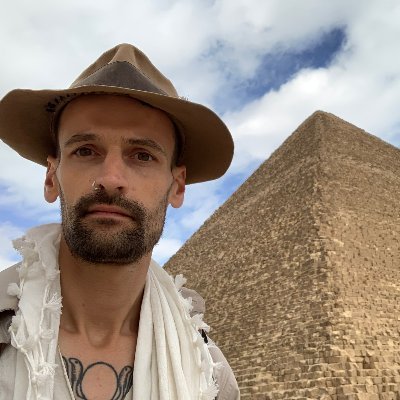
Trevor Grassi is a researcher, field investigator, filmmaker, and founder of the Archaeological Rescue Foundation, whose work focuses on ancient-site anomalies, hidden structures, suppressed history, non-invasive archaeology, and the unresolved mysteries surrounding the Giza Plateau.
Trevor’s path into the mysteries of ancient civilization began through an extraordinary personal connection with the late John Anthony West, the pioneering Egypt researcher whose work helped reopen the debate around the age, meaning, and hidden history of the Sphinx. Through West’s friendship, guidance, and access to his personal library, Trevor was introduced to a deeper level of inquiry into Egypt, symbolism, ancient wisdom traditions, and the possibility that the accepted timeline of civilization may be far too limited.
Since then, Trevor has become one of the most visible independent researchers following the groundbreaking developments connected to the search for a Second Sphinx and the deeper architectural mysteries beneath and around the Giza complex. His analysis brings together historical sources, site research, imaging data, geometry, comparative archaeology, and a willingness to ask difficult questions about what may still remain hidden beneath one of the most studied landscapes on Earth.
In recent years, Trevor has been one of the strongest public champions of Dr. Filippo Biondi and the innovative non-invasive scanning protocol being applied to ancient sites. Through the Archaeological Rescue Foundation, Trevor has helped bring attention to the potential of advanced SAR-based imaging and micro-motion analysis to investigate hidden structures without damaging sacred or protected archaeological landscapes. His work is helping place non-invasive archaeology at the center of the next stage of discovery.
At Disclosure in Mackinaw, Trevor will present key developments connected to the Giza Plateau, including the search for a Second Sphinx, the possibility of previously unknown underground structures, and investigations related to the legendary Hall of Records. His work also explores how ancient traditions, modern scanning technologies, forgotten testimony, overlooked shafts, blocked entrances, and historical clues may be converging in ways that could challenge long-held assumptions about Egypt’s past.
Trevor will also bring glimpses from his broader body of work, including film projects now in development and investigations that reach beyond Egypt into other ancient mysteries and field discoveries. His presence at the conference promises rare insight into evidence, footage, and questions that many people have not yet seen presented in a connected way.
A unique part of Disclosure in Mackinaw will be Trevor’s collaboration and friendship with Frank Rogala. Frank and Trevor have traveled, investigated, filmed, and explored together through extraordinary circumstances, including recent expeditions connected to Piedras Negras, Mexico, ancient artifacts, crystal skulls, and hidden-site research. This may be the first time their real camaraderie, humor, trust, and shared field experience will be on display through presentations, sit-down discussions, and informal campfire conversations with attendees.
That matters, because some of the most mind-expanding parts of this work do not happen in polished lectures. They happen when researchers who have been in the field together begin comparing notes, challenging each other, remembering details, and connecting discoveries across disciplines. At Disclosure in Mackinaw, audiences will have the chance to witness some of those conversations in real time.
Trevor’s strength is his ability to take highly complex material and make it understandable without stripping away its depth. He brings a careful, investigative approach to subjects that are often either dismissed too quickly or sensationalized too easily. His presentation will help audiences understand why the latest developments in Egypt matter, what the evidence suggests, and why the story of the Sphinx, the Giza Plateau, and the hidden structures beneath it may be far larger than most people have been told.